your blue island ai

Every AI built from your expertise failed for the same structural reason.

It was built to reflect what you produced. We build the opposite: a system that reasons the way you actually decide, defers instead of inventing, and is yours on your own machine.

See it work on one of your own real decisions first.

01 / why the last one failed

The problem has a name. It is The Output Mirror.

You were told the problem was you. Too nuanced to encode. Thirty years that does not fit in a machine. Foolish to even try.

None of that is true. Every prior attempt was built the same way: it ingested what you had already produced, the articles, the talks, the transcripts, and reflected that surface back.

A mirror can only return what is placed in front of it. What it can never return is the reasoning underneath, the rules you apply without naming them, and above all the refusals.

You never published your refusals, the calls you would never make. So no mirror can hold what was never on the page.

a mirror fails in three exact ways

It forgets you.
A mirror holds nothing. It is blank the moment you walk away, and every conversation starts from zero.
It invents things.
Ask it anything past the surface and it has no model of how you decide, so it makes something up, fluently and confidently and wrongly. It bluffs because it never learned where your competence ends.
It flattens you.
It averages the output and loses the discernment, the specific "I would never advise that" that makes the work unmistakably yours.

So read this slowly, because it lifts a verdict you may have quietly passed on yourself.

You did not fail at building an AI of yourself. The thing you were handed was built to reflect what you produced, and it was never going to hold what you never produced.

The bottleneck is never the AI. It is that no one has ever excavated how you decide.

We call the thing you tried The Output Mirror. Naming it is the first honest thing anyone has told you about why it did not work.

02 / the second trap

And even what it manages to hold, you do not own.

The first failure is fidelity: a mirror never truly holds your judgment. The second has nothing to do with how good it is. Everything you feed it lives on someone else's machine, under terms you do not set.

Every refinement, every correction, every hour you spend making it less wrong, the tool keeps. Not you. You are not building an asset. You are improving a product you will never own.

And the rental has a kill switch. Stop paying and it does not slow down or degrade. It is gone, and everything you have taught it goes with it, locked behind a door you do not hold the key to.

You are not building an asset. You are renting your own expertise back.

This is the quiet cost of pouring your life's work into a tool you do not control. It does not compound for you, it cannot leave with you, and it is not yours to keep, to sell, or to build on.

Your judgment is the most valuable thing you own. It should not live as a lease, with your expertise as the deposit. It belongs on your own machine, owned outright.

03 / what it would actually take

Put the two failures together, and the fix defines itself.

A mirror is hollow, and it is never yours. So the thing you actually need is the opposite on both counts. Three things have to be true at once, and no tool you have tried even attempted all three.

Built from how you decide.
Not from the finished work you already produced. From the reasoning underneath it, dug out of your own real decisions, one at a time.
It knows what you refuse.
So when a question runs past where your judgment goes, it declines instead of bluffing. The refusals are the part no mirror could ever hold.
You own it.
Outright, on your own machine. It compounds for you instead of renting back to you, and it does not vanish the day you stop paying.

That is not a better mirror. It is a different kind of thing entirely. A mirror reflects what you said. What you actually need is something that learned how you decide, and applies it in the rooms you are not in.

An apprentice, not a clone. A clone copies the surface. An apprentice learns the judgment beneath it, and keeps learning, case after case, until it reasons with the judgment of a master. The master is you.

There is only one way to build that. Not a signup, which can only start from what you upload, but a person, digging out how you actually think on your own real decisions. That is the work. Here is how it is done.

04 / the judgment excavation method

We don't reflect your output. We excavate how you decide.

We call it The Judgment Excavation Method. Four moves, performed by a person, on your own real decisions.

01

The Dig

How you actually decide, surfaced case by case: the reasoning beneath the output, the rules you apply without naming them. The field skips this entirely.

02

The Refusal Map

What you will not do: the advice your method forbids, the line you do not cross. This is the exact reason the result can defer instead of bluff.

03

The Apprenticeship

Your logic, encoded. The system reasons through new questions the way you would, and defers to you on anything genuinely novel. You remain the master it learns under.

04

The Owned Vault

It lives on your own infrastructure. You own it outright. It does not die if you stop paying, and for a regulated firm it clears the bar hosted tools cannot.

The field could not reproduce this even if it wished to. A self-serve signup is the absence of The Dig.

A hosted product cannot offer The Owned Vault, because its revenue depends on you never owning the asset. Each competitor would have to abandon the model that funds them to perform this method.

That is not a clever advantage. It is a structural one.

05 / two ways in

One method. Two kinds of expert.

The work is the same; the reason you own it is different.

an apprentice, not a reflection

Because it was built from how you decide, it declines what it has not earned the right to answer. It defers on the genuinely novel instead of inventing, and it does not bluff in your name.

A mirror cannot do this. Deferral requires knowing the edge of your competence, and that edge was never in your output. The Refusal Map is what puts it there.

owned, on your own machine

You own the vault outright. It is not a hosted subscription that ends when payment stops. It stays private, it compounds with every case, and it is the asset a buyer can verify rather than rent.

For a regulated firm, the ownership is what unlocks the budget: confidentiality requirements disqualify hosted tools before price is even discussed.

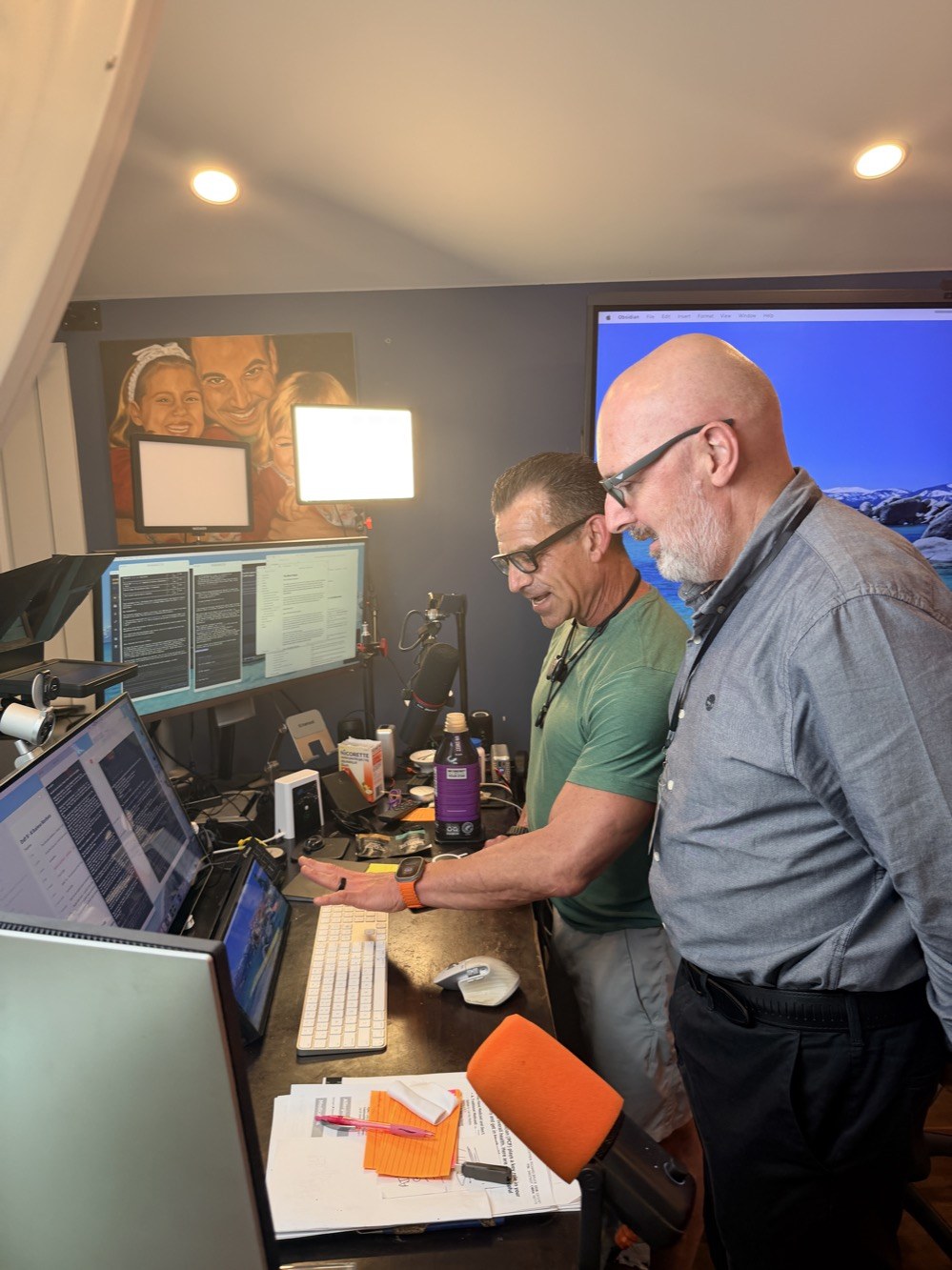
Koen de Wit and Rich Schefren working together
koen de wit and rich schefren, zenith pro
koen de wit the funnel therapist rich schefren · zenith pro
06 / who is behind this

A method this personal is not run by a platform. It is run by a person.

This is not a product with a signup. It is bespoke work done by a person on your real material, so it is fair to ask who.

Your Blue Island AI is the work of Koen de Wit. For close to a decade, under his practice The Funnel Therapist, he has helped coaches, consultants, speakers, and creators with their marketing and their funnels.

The reason a person sits here and not a signup form is the whole argument of this page. The Dig and The Refusal Map cannot be performed by software. Excavating how you decide is the un-commoditizable work no signup can do on your behalf.

He is a member of Rich Schefren's Zenith Pro, one of Schefren's signature programs, and joined Rich for a private two-day workshop at Rich's home in Delray Beach.

Rich Schefren is a business strategist. The principle this draws from is simple: the most valuable part of an expert's thinking is the part that never makes it onto the page. That is exactly what this method exists to recover.

a few of the people koen has worked with

Creators with YouTube audiences approaching a million and beyond: Dr. Orion Taraban (PsycHacks), Brian Scott (The Reality Revolution), and Olympic medalist Tony Jeffries (Boxing Fitness Academy).

Coaches and authors with real bodies of work: Jessica Cunningham (Belief Coding) and Cicely Simpson, award-winning author of "Pull Up Your Chair."

Two Comma Club winners and seven-figure experts: Jeremy Miner (7th Level), Natasha Takahashi, Bruce Guan, and Ben Robinson.

And the rooms behind them: consultants who are approved providers to Meta, Google, and Amazon. He also consults for ClickFunnels in their funnel-builder coaching and certification program.

The size of the following was never the point. What these people share is expertise worth excavating, and that is the only thing that matters here, whether you are known to millions or to the few hundred clients who pay you precisely because of how you think. The judgment in every one of these engagements belonged to the expert. The work was to recover it and hand it back. That is the work here.

07 / begin

Watch your own judgment reproduced, on one real decision, before you commit to anything.

Begin with The Excavation: a bounded engagement on one of your real matters, where The Dig and The Refusal Map are performed in front of you.

The system makes the call the way you would, and declines the one your method forbids. You see it work on your own material, not on a promise.

The act of you editing what it produces is itself the proof that you remain the author and the authority.

The build that follows is bespoke, priced from what your practice actually needs, with no package menu, and what you pay for The Excavation credits toward it.

Start with one real decision of yours.